
In the story “A Scandal in Bohemia” it became very obvious that Sherlock Holmes was in love with Irene Adler. Though, as Watson mention in the beginning, he simply refers to her as simply “the woman”. He tries to deny his love for Irene Adler because he does not wish to show his emotions to Watson so he hides it. She is very clever which makes Holmes desire her even more, as she fools him, giving him a note which gives him what he want: The case to end. This was not satisfying enough as he knew she was officially taken. When someone is in love with someone it saddens them to see them with someone else, not because they wish that the love of their life was unhappy but because it hurts to know you will be unable to hook up with them. I have only watched the first Sherlock Holmes movie starring Robert Downey Jr. and not the others such as the one with Irene Adler, but I will try and watch it with my family once I get the chance.
Category: Uncategorized
The Remarkable Characteristics of Sherlock Holmes
There are many shows which have elements of Sherlock Holmes within them. One of those shows happens to be Monk. Though I do not watch it, I have at some point seen my brothers and mother watching it. I have gotten the general idea, Sherlock Holmes is a bit of a germaphobe and so is Monk. Monk has a fine attention to detail, and both have taken on some lighter cases. Both of them were bullied as children and tended to be quieter then some. The both of them do not have time for serious relationships and tend to stay away from them. The both of them have a very fine attention to detail and can point out the smallest flow in just about anything. If something does not belong they can spot it a mile away, continuing the investigation as they do not want to be wrong. If they get something wrong they simply scuff and do not believe it. Holmes is an individual character of Arthur Conan Doyle’s imagination, so he is technically a relic of the past but also not. His characteristics can be impersonated but not perfectly to the touch, he is truly a remarkable character and was very important to the Victorians who wished for justice to prevail.
“Red-Headed League”
Sherlock Holmes, in “The Red-Headed League”, was a bit surprising in that Homes actually asked for Watson to stay when he accidentally intruded when Holmes was in a conversation with a client. He wanted Watson’s advice with asking the client the information about the case. During the conversation it was very obvious that Holmes was clearly very smart as he did indeed point out Jabez Wilson’s social status and where he had been and where he had visited (Asia). He pointed out every emblem on the man’s body, it was very impressive. For Holmes, a man of great intelligence along with Watson, they were able to crack the case very quickly finding out that a member of the royal family had planned to rob a local bank through use of tunneling below it using Mr. Wilson’s shop. Wilson trusted his employee to watch the shop while he was distracted by a made up organization they had made that they called “The League of Red-Headed” men. Since I watched Robert Downey Jr. play as Sherlock Holmes it was not a surprise. Though John Watson played a role in the story he was more the less in Holmes’s shadow. The Narrative Watson had provided was very interesting, and somewhat surprising but sort of what I expected (minus Holmes asking for Watson’s advice).
How Sherlock Holmes Relates to Blue’s Clues
There are many images people have made portraying Sherlock Holmes, the fictional character created by Arthur Conan Doyle in his series of stories of Sherlock Holmes like “The Red-Headed League” and “A Study in Scarlet”, etc. Sherlock Holmes is a story that many of us have known about for quite a while. In popular culture today cartoon characters try to teach similar characteristics to children. One cartoon that does this would have to be “Blue’s Clues” as it teaches children to have perception and rely on their senses of smell and touch. Blue helps Steve to smell where as Steve helps Blue with his sense of touch. They work as a team, much like Watson helps Sherlock with different personal things along with investigations, and Sherlock generally points out danger and helps to solve it along with being quick with his head in finding clues and getting out of trouble.

The Fame of Freak Shows
Contrary to popular believe, Victorian freaks actually made more money than their managers and were the early celebrities before television came along. The lifes of these freaks was amazing, and were loved by the crowds, with a cult-like following. Freaks were able to Express themselves, if they wanted to be a Duke, King, Knight or an Uhlan, etc., then they could be. Even if people were simply fascinated by the way they looked, people could also be fasinated by their made up personality and attire. One of these freaks, who’s name was Charles Sherwood Stratton, also known as General Tom Thumb who looked like a child. He met with Abraham Lincoln and Queen Victorian, he was internationally known. His manager’s was P.T. Barnum. Stratton died in New York City in 1883, very wealth. Since the decline of freak shows the managers were unable to pay the freaks as highly, managers used to basically be just like managers for Hollywood celebrities. This was a meager surprise to me, and I’m glad I looked it up.
https://the-line-up.com/freak-show-peculiar-attraction-victorian-era
Imperialism in “Rikki Tikki Tavi”
In the story “Rikki Tikki Tavi” we are presented with a mangoes named Rikki that represents Indians that were in favor of Great Britain’s imperial rule. The family represents Great Britain, and the snakes represent resistance against imperial Great Britain. The mangoes defeats the snakes, winning the respect and live of the family. In the begining Ricki was seen as broken and nearly dead, but as the story progresses we see that Ricki has made himself a hero later making his ultimate victory against the snakes (resistance to imperial rule). When Great Britain took over India it was because they wanted to help civilize it, they leginimately had the desire to help other country. It was all with good intentions, and whether achieved appropriately it did indeed come true but unfortunately at a cost.
The Mad Political Tea-Party
When I first saw the title “A Mad Tea-Party” I honestly thought it was just a story explaining why “tea time” had been created. When I noticed it said Lewis Carroll was the author and noticed what it was I felt… Well, pretty dumb. When I heard this was the author of “Alice in Wonderland” I was suprised to figure out that the Mad Hatter represented a Politician along with the March Hare. They were much more Political they I thought they’d be and tended to try to use “the best butter”. This butter was used to fix the watch, something that clearly didn’t work. This meant to represent Politicians and their inability to solve any issues properly, using only “the best butter”.
“Walrus and the Carpenter” and Child Labor
In Lewis Carroll’s “The Walrus and the Carpenter” it symbolically discusses child labor and talks about the young child works he symbolizes as “little Oysters”. In the poem the Walrus is meant to represent the factory owner who does not care about the lives of the “Oysters” but of the riches they make his stomach feel when he consumes them, the Carpenter is the man who leads the “Oysters” to this Walrus. The Carpenter is essentially the foreman and the man looking for these “little Oysters” to hire for his boss, the Walrus. During the Victorian Era, the issue of child labor was a very serious one in that children would simply work and not be able to receive a proper education. This would be slightly less of an issue if only the children did not have such poor conditions in these factories and such a large number of accidents which would leave them disfigured or simply dead.
https://baheyeldin.com/literature/symbolism-lewis-carroll-walrus-and-carpenter.html
Lewis Carroll’s Photography
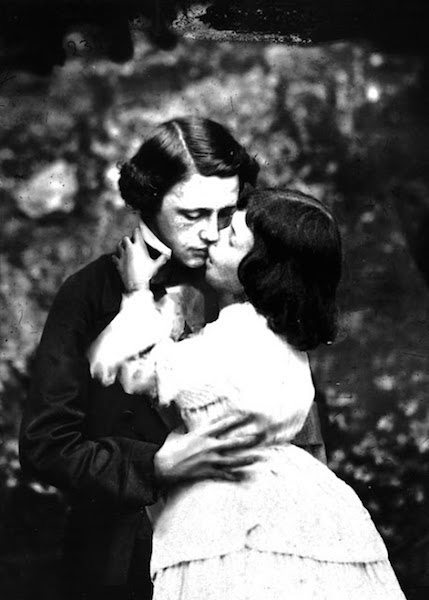
Although Lewis Carroll does appear to some like a pedophile it is just too hard to know for sure. He genuinely connects socially to children as they do not expect him to articulate when speaking. Recent accusation if child abuse was brought against R. Kelly, who I believe is at least guilty of peeing on that young 14-year-old girl back in that 1994 tape. R. Kelly in my mind is absolutely guilty, while Lewis Carroll still remains a mystery to me. Whether R. Kelly is accused of the recent allegations against him I believe that Lewis Carroll may be a pedophile, but may also not be… He is a confusing man, I honestly don’t know whether or not he is or is not.
https://www.spin.com/2017/07/r-kelly-sexual-misconduct-allegations-timeline/
https://www.thisisinsider.com/r-kelly-sexual-abuse-and-child-porn-allegation-2019-1
The “Goblin Market”
In Christina Rosseti’s “Goblin Market” she talks about about FRUIT! A lot of sexually explicit parts of the poem were explained by FRUIT which seemed to… SO MANY DIRTY JOKES! UH! The fruit was… sucked? Well, the woman’s virginity was described as a FRUIT. but surprisingly not as a cherry (not to be too “gross”). Even though it was meant to be a somewhat sad poem, the way Mrs. Vance said “FRUIT!” made it very funny, and the description she provided. It could definitely relate to today’s society in that if a woman is no longer a virgin and is known to have slept with two or more men it is very unlikely that she will marry or remarry. Some people are not very picky though, but many are. Truthfully, teens both male and female have some form of an expectation to get “laid” on prom night, while of course with women it is less of a thing while with men they will relentlessly tease each other while secretly some are still virgins as well. The FRUIT would still have to in my mind represent the virginity. Of course the story talks about sucking fruit and having it in her face, something I couldn’t stop laughing about. Perhaps I did not hear the story clearly but that is definitely how it sounded to me. The story was very important to the Victorians, but is just as important today as we do have this same type of idea just not as seriously as the Victorians did.
 Humanites 101 Blog Site